Greece & Rome · 2026
University of Alcalá
Christian San José Campos
Ancient History · Hellenistic History and Historiography · Carthage
Academic profile
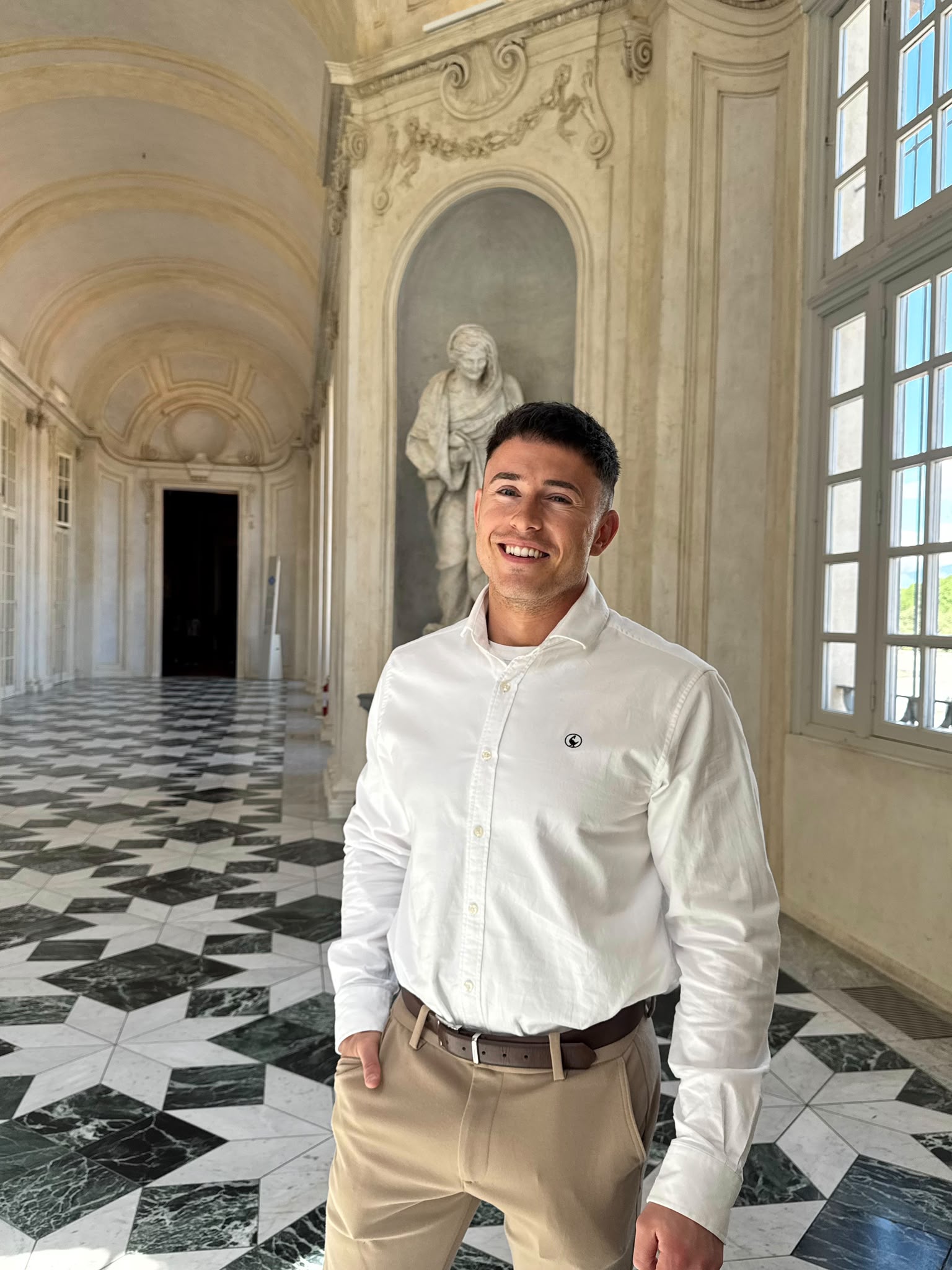
I grew up in Madrid and moved to Alcalá de Henares to study for a BA in History at the University of Alcalá. I then completed a master’s degree in Ancient Mediterranean Studies at the Open University of Catalonia before returning to Alcalá, where I am currently a PhD candidate in Ancient History.
My research focuses on the history and historiography of the Hellenistic world, with a particular interest in Carthage. The identification of the Hellenistic period as a distinct era of ancient history dates back to the nineteenth-century work of Johann Gustav Droysen. The period is conventionally dated from Alexander the Great’s death in 323 BC to the Roman conquest of Egypt in 30 BC. My work on historiography examines how and why accounts of the past were written and transmitted.
Online profiles
Featured publication
Research visits
 2026KU LeuvenLeuven, Belgium · 1 October–30 November · In progress
Host supervisor · Stefan Schorn
 2025University of EdinburghEdinburgh, United Kingdom · 6 January–29 March
Host supervisor · Andrew Erskine
 2024Università Cattolica del Sacro CuoreMilan, Italy · 1–29 November
Host supervisor · Giuseppe Zecchini
Research interests
My research on Carthage spans the period from 323 BC to the city’s destruction by Rome in 146 BC. I ask how and to what extent Carthage participated in the institutional, social and cultural developments documented elsewhere in the central and eastern Mediterranean during the Hellenistic period.
These questions inform my doctoral thesis, Hannibal Barca and the imitatio Alexandri: Power and Representation in the Hellenistic World. It examines the extent to which models of power and authority associated with Alexander the Great and developed by the Hellenistic monarchies were adapted to Carthage’s African and republican traditions in the third and second centuries BC. I approach this question through Hannibal Barca, the best-documented Carthaginian in the surviving literary sources. Studying his career allows me to explore how Carthage’s aristocracy understood and exercised power.
Alongside my doctoral research, I investigate specific questions in Hellenistic historiography, particularly how and why ancient authors wrote about Carthaginian civilisation. I also examine Alexander the Great’s influence across the Mediterranean.
Looking for the evidence
Who guided Hannibal Barca across the Alps in 218 BC? Silenus, a Greek historian who accompanied the Carthaginian general, described a dream in which a divine guide led Hannibal towards Italy. His account survives indirectly through Cicero. In his account of the crossing, the second-century BC Greek historian Polybius emphasises the role of local guides and criticises explanations involving divine intervention. He says that he questioned participants in the expedition and travelled through the mountain passes himself. This example highlights the distance between an event and the ways it was narrated, transmitted and interpreted.
That same attention to terrain informed Polybius’s reading of Callisthenes, the historian who accompanied Alexander the Great on his campaigns. Examining his account of the battle of Issus, Polybius asked whether the battlefield could accommodate the armies as Callisthenes described them. His criticisms preserve a substantial fragment of a work now lost. To follow Alexander’s reign as a whole, however, we rely on much later narratives. The earliest surviving substantial account is Book 17 of Diodorus of Sicily’s Library of History, written in the first century BC, nearly three centuries after Alexander’s death.
Literary texts, whether complete or fragmentary, are just one part of the evidence. Documents also reveal what different communities chose to record, according to their needs and interests. Babylonian scribes recorded Alexander’s victory at Gaugamela (331 BC) alongside their observations of the moon. A marriage contract from Egypt sets out the commitments made by Demetria and Herakleides, while a Punic inscription from Carthage names those responsible for public works. A coin found far from its mint or an excavated farmstead in Punic Sardinia can also shed light on activities and communities that rarely appear in literary accounts.
The historical importance of an event does not guarantee that evidence for it will survive. An object, interpreted in context, can shed light both on an event and on how it was narrated. Polybius says that in southern Italy he consulted a bronze tablet on which Hannibal had listed the troops he left in Iberia. This tells us where his figures came from; the reasons for that deployment require further investigation. The historian’s task is therefore to place each testimony in context, compare it with other evidence, and ask what its author could have known, who their readers were and what interests might have shaped their account.
Sources and further reading
Ancient evidence
- Dionysius of Halicarnassus, Roman Antiquities 1.74.1.
- Cornelius Nepos, Hannibal 13.3.
- Cicero, On Divination 1.49 (Coelius Antipater’s account, drawing on Silenus).
- Polybius, Histories 3.33.17–18; 3.47.6–48.12; 12.17–22.
- Diodorus Siculus, Library of History, Book XVII.
- Babylonian astronomical diary recording the battle of Gaugamela (331 BC), British Museum, BM 36761.
- Marriage contract of Demetria and Herakleides, Elephantine (310 BC), P.Eleph. 1.
- Verse epitaph from Miletus, Milet VI.2, 733.
- Public works inscription from Carthage: A. Dupont-Sommer (1968), pp. 117–118; full publication below.
- Decree of Xanthos for Kytenion, Supplementum Epigraphicum Graecum 38.1476.
Studies and further reading
- Droysen, J. G. (1836–1843). Geschichte des Hellenismus, 2 vols. Hamburg: F. Perthes.
- Dupont-Sommer, A. (1968). “Une nouvelle inscription punique de Carthage”. Comptes rendus des séances de l’Académie des Inscriptions et Belles-Lettres 112.1, pp. 116–133 (especially pp. 117–118).
- Gabba, E. (1981). “True History and False History in Classical Antiquity”. The Journal of Roman Studies 71, pp. 50–62 (especially pp. 51–52).
- Ligota, C. R. (1982). “‘This Story Is Not True.’ Fact and Fiction in Antiquity”. Journal of the Warburg and Courtauld Institutes 45.1, pp. 1–13 (especially pp. 7–8).
- Alföldy, G. (1983). “La Historia Antigua y la investigación del fenómeno histórico”. Gerión 1, pp. 39–61 (especially pp. 45–48, 54).
- Finley, M. I. (1986). Ancient History: Evidence and Models. New York: Viking (especially pp. 13–15, 30–32).
- Gómez Espelosín, F. J. (1989). “Los riesgos de la distancia o algunas reflexiones sobre la irrecuperabilidad del mundo antiguo”. Cuadernos de Filología Clásica 23, pp. 97–116 (especially pp. 109–111, 115–116).
- Bonnet, C. (2005). “Carthage, l’« autre nation » dans l’historiographie ancienne et moderne”. Anabases 1, pp. 139–160 (especially pp. 139–141).
- Bonnet, C. & Krings, V. (2006). “Les Phéniciens, Carthage et nous: histoire et représentations”. In J. P. Vita & J. Á. Zamora (eds.), Nuevas perspectivas I: la investigación fenicia y púnica (Cuadernos de Arqueología Mediterránea 13). Barcelona: Edicions Bellaterra, pp. 37–47 (especially p. 44).
- Bosworth, A. B. (2006). “Alexander the Great and the Creation of the Hellenistic Age”. In G. R. Bugh (ed.), The Cambridge Companion to the Hellenistic World. Cambridge: Cambridge University Press, pp. 9–27 (especially p. 9).
- Bettenworth, A. (2007). “The Mutual Influence of Inscribed and Literary Epigram”. In P. Bing & J. S. Bruss (eds.), Brill’s Companion to Hellenistic Epigram: Down to Philip. Leiden/Boston: Brill, pp. 69–93 (especially pp. 79–80).
- Green, P. (2007). Alexander the Great and the Hellenistic Age: A Short History. London: Weidenfeld & Nicolson (especially pp. xiii, xxi–xxiv).
- Heckel, W. (2008). The Conquests of Alexander the Great. Cambridge: Cambridge University Press (chapter 2).
- Van Dommelen, P., Gómez Bellard, C. & Tronchetti, C. (2008). “The Punic farmstead at Truncu’e Molas (Sardinia, Italy): excavations 2007”. Antiquity 82 (315), Project Gallery.
- Chaniotis, A. (2016). “History as an Argument in Hellenistic Oratory: The Evidence of Hellenistic Decrees”. In M. Edwards & P. Derron (eds.), La rhétorique du pouvoir: une exploration de l’art oratoire délibératif grec (Entretiens sur l’Antiquité classique 62). Vandœuvres–Genève: Fondation Hardt, pp. 129–174 (especially pp. 155–160).
- Chaniotis, A. (2018). Age of Conquests: The Greek World from Alexander to Hadrian. Cambridge, MA: Harvard University Press (especially p. 334).
- Heckel, W. (2020). “Creating Alexander: The ‘Official’ History of Kallisthenes of Olynthos”. In R. Faber (ed.), Celebrity, Fame, and Infamy in the Hellenistic World. Toronto: University of Toronto Press, pp. 199–216 (especially p. 205).
- Ash, R. (2021). “The Staging of Death: Tacitus’ Agrippina the Younger and the Dramatic Turn”. In A. Damtoft Poulsen & A. Jönsson (eds.), Usages of the Past in Roman Historiography. Leiden/Boston: Brill, pp. 197–224 (especially p. 202, n. 20).
- Grethlein, J. (2023). “Motivation”. In Ancient Greek Texts and Modern Narrative Theory: Towards a Critical Dialogue. Cambridge: Cambridge University Press, pp. 115–147 (especially pp. 115–117).
- Oughton, C. W. (2024). “A battle of exemplarity and narratorial self-reference at Livy’s Zama”. In O. Devillers & B. B. Sebastiani (eds.), Sources et modèles des historiens anciens, 3 (Scripta Antiqua 182). Bordeaux: Ausonius, pp. 137–154 (especially pp. 137–140).
- Ashmolean Museum (n.d.). Coins at the Crossroads of Asia. Online exhibition. Oxford: Ashmolean Museum.
Publications
Journal articles
- 2026
- 2026
Melqart y Heracles en Gadir: el lenguaje ecuménico del Mediterráneo desde el extremo Occidente
Hesperia. Culturas del Mediterráneo extra 29, España y el Mediterráneo I, 33–40 - 2025
Hamilcar Rhodanus, a Carthaginian Spy in Alexander’s Army? A Historiographical Perspective
Deimos. Zeitschrift für Antike Militärgeschichte 1, 46–60 - 2024
- 2022
The Murder of Hasdrubal and the Problematic Literary Transmission in Classical Sources
Eirene. Studia Graeca et Latina 58.1–2, 297–337 - 2022
- 2021
Cartago y Alejandro. El problemático rastreo de unas relaciones
Antiguo Oriente 19, 193–232 - 2021
Cartago en el contexto helenístico: procesos y consideraciones
Cartagine. Studi e Ricerche 6, 1–40Author’s copy · Academia.eduDOI: 10.13125/caster/4300 · publisher link unavailable - 2021
Alexander the Great in Persepolis
Karanos. Bulletin of Ancient Macedonian Studies 4, 13–33 - 2020
- 2020
- 2019
Los elefantes de Aníbal
Espacio, Tiempo y Forma. Serie II, Historia Antigua 32, 75–94
Book chapter
- 2024
Alexander, “the Great”? Alexander’s Meaning during the Second Punic War
Filalexandros: La última frontera de Alejandro. Homenaje al profesor Francisco Javier Gómez Espelosín A. I. Molina Marín & M. Agudo Villanueva (eds.), Editorial Universidad de Alcalá, 295–312
Book reviews
- 2025
F. J. Gómez Espelosín, Las geografías de Alejandro
Ancient History Bulletin Online Reviews 14, 1–3 - 2025
E. Nicholson, Philip V of Macedon in Polybius’ Histories: Politics, History, and Fiction
Studia Historica. Historia Antigua 43, e31936
Forthcoming
Book reviews accepted for publication.
B. Antela-Bernárdez, Alexander the Great in Love: Desire, Violence and Gender in the Conquest of Asia
Karanos. Bulletin of Ancient Macedonian Studies
R. M. Loehr, Emotion and Historiography in Polybius’ Histories
Talanta: Proceedings of the Dutch Archaeological and Historical Society
Conference papers and seminars
Conference papers, invited talks and research seminars on Carthage, Alexander and the writing of ancient history.
- 24 Jun 2026
Hannibal as a Hellenistic Figure: The Making of a Historiographical Paradigm (c. 1870-2020)
IX Jornada Internacional de Jóvenes Investigadores ANIHO-XI SHRA, Vitoria.
- 8-12 Jun 2026
Alexander the Great and Hamilcar Rhodanus: A Carthaginian Spy?
War in the Ancient World International Conference, Complutense University of Madrid.
- 5 Dec 2025
Iberoamérica y los Estudios Helenísticos: Temas y Métodos
Invited roundtable, Ibero-American Network of Hellenistic Studies, University of Concepción, Chile.
- 7 Nov 2025
Ptolemy I and the West: Exemplifying an Unfinished Policy and the Creation of the Western Clause in Alexander’s Hypomnemata
Postgraduate Work in Progress Seminar, Institute of Classical Studies, University of London.
- 7 Feb 2025
The imitatio Alexandri of Hannibal Barca? The Creation of the Hellenistic Hannibal over the Last Century
Edinburgh Classics PGR Seminar Series, University of Edinburgh.
- 21-23 Nov 2024
Hannibal Barca and the imitatio Alexandri: From the Nineteenth-Century Conception to the Hellenistic Hannibal
Annual Meeting of Postgraduates in the Reception of the Ancient World, University of Malta.
- 10 Jul 2024
Hannibal’s Elephants: Some Thoughts
War and Writing: Animals in War, University of South Africa.
- 14 Jun 2024
Hannibal’s Elephants and the Rhône: Military Issue or Historiographical Misinterpretation?
Guest lecture, War in the Ancient World International Conference, University of Graz.
- 18-19 Apr 2024
Notes on Hannibal’s Designation as New General: Education and Opposition
Annual Meeting of Postgraduates in Ancient History, University of Cardiff.
- 18-26 Sep 2021
Ptolemy I and the West: Exemplifying an Unfinished Policy and the Creation of the Last Plans
I Jornadas Estudiantiles de Egiptología, University of Alcalá.
- 25-26 Mar 2019
Hannibal’s Elephants
IV Jornadas sobre el Mundo Antiguo, Autonomous University of Madrid.
Contact
For academic correspondence, you can reach me at either of these addresses.
Useful links
A starting point for finding scholarship on Macedonia and Carthage, reading inscriptions and identifying journal abbreviations.
Journals and book series
Karanos. Bulletin of Ancient Macedonian Studies
An open-access journal on ancient Macedonia and the Hellenistic kingdoms, with articles on history, archaeology and historiography. Its directors are Borja Antela, Mario Agudo Villanueva and Marc Mendoza Sanahuja.
Edinburgh Studies in Hellenistic History and Culture
An Edinburgh University Press series edited by Andrew Erskine and Benedikt Eckhardt, exploring the history and culture of the Hellenistic world, from Sicily to Mesopotamia.
Editorial Universidad de Alcalá
Its GAHIA monographs explore how ancient authors described places and wrote history.
Societies and networks
Scuola Archeologica Italiana di Cartagine (SAIC)
Research, training and archaeological cooperation on Carthage and North Africa, with activities and publications on ancient Mediterranean societies.
The Classical Association
A UK association supporting the study and teaching of the ancient world through publications, conferences and educational resources.
Sociedad Española de Estudios Clásicos (SEEC)
Conferences, activities and the journal Estudios Clásicos for people who study or teach the Greek and Roman world.
The Antigonid Network
A network studying the Antigonid dynasty and its relations with other Hellenistic powers, co-directed by Emma Nicholson at Exeter and Annelies Cazemier at Southampton. It hosts seminars and brings together sources and scholarship.
GAHIA · Geography and Historiography in Antiquity
An international association for ancient geography and historiography, established through collaboration between researchers at Alcalá, Seville and Málaga. It promotes research, meetings and publications on how ancient writers described the world.
Lectures from the Fundación Juan March
Estudiosos viajeros griegos
A lecture by Francisco Javier Gómez Espelosín, delivered on 14 February 2019, on travel and its role in establishing the authority of Greek accounts. Video in Spanish.
Cartago y Aníbal, el más temible contrincante de Roma
Manuel Bendala Galán · 19 November 2019. Carthage, Hannibal and the influence of Alexander’s model of power on the Barcid family. Video in Spanish.
Alejandro Magno: conquistar los confines de todas las tierras
Adolfo Domínguez Monedero · 3 November 2015. Alexander’s life and campaigns, and the connections between conquest, exploration and knowledge. Video in Spanish.
Termópilas (480 a. C.): tres días de contienda, 2500 años de posteridad
Eduardo Sánchez Moreno · 14 January 2021. The battle’s historical context and the creation of its heroic memory in literature, art and film. Video in Spanish.
Abbreviations and citation
L’Année philologique · UC Berkeley Library
Look up the full title behind a journal abbreviation used in L’Année philologique.
American Journal of Archaeology (AJA)
The journal of the Archaeological Institute of America gives examples of references to books, articles and online material in bibliographies and notes.
Coins and inscriptions
PELLA · American Numismatic Society
A catalogue of Argead coin types, including issues in the names of Philip II, Alexander and Philip III. It brings together images, measurements and information about mints and coin hoards from international collections.
Acuñaciones cartaginesas en Iberia · MAN
The Museo Arqueológico Nacional’s Hispano-Carthaginian coins, with collection records and downloadable catalogues covering issues associated with Carthaginian rule in Iberia and the Second Punic War.
Hellenistic Royal Coinages
Compare coin types issued in the names of Alexander and the kings who succeeded him.
Coins of the Bactrian and Indo-Greek Rulers · BIGR
A catalogue developed by Oxford and the American Numismatic Society, drawing on collections including the Ashmolean and Cambridge’s Fitzwilliam Museum. Explore the coinage of Graeco-Bactrian and Indo-Greek kings and queens.
I.Sicily
An open catalogue of inscriptions from ancient Sicily in Greek, Latin, Punic and other languages.
Inscriptions of Greek Cyrenaica · IGCyr² / GVCyr²
Open editions of Greek inscriptions from Cyrenaica, with texts, translations, commentary and images. The revised 2024 edition provides evidence for institutions, connections between communities and individual lives in ancient North Africa.
Image credits
- Paintings
- The reproductions of Goya, Altdorfer, Turner and Veronese are in the public domain. The Chifflart and Tiepolo images are provided under CC0 by Paris Musées and the Getty respectively. See individual credits
- Coins and inscriptions
- The Cleveland Museum of Art supplies both faces of its two coins under CC0. The two drawings of the Mazarrón coin use the Berlin Academy scan (CC BY-SA 4.0). The photograph of the Carthage inscription is shared under CC BY-SA 3.0. Mazarrón credits Inscription credits
- Portrait
- Self-portrait by Christian San José Campos, cropped for display.
- University building drawings
- The university building drawings were created for this website; they are not institutional logos.
- Image processing
- Reproductions are resized and converted to WebP for the web. Coin faces are shown separately; the Mazarrón drawings have their backgrounds removed. Source and licence links accompany each image. The CC BY-SA licences apply to the images identified above, not to the whole website.
- External publications
- Article links lead to the publisher or journal; an issue or volume link leads to the complete publication’s record, and an abstract link provides only the summary. Author’s copies are hosted on Academia.edu, which may require an account. The website does not host copies of these publications.